
No. 03 — The Silhouette Atlas
Dress Styles & Silhouettes
Fifteen dress styles for women, drawn as technical plates and decoded one by one.
Every dress starts as an outline. Where it fits and where it releases, where the waist sits and how the hem falls — this is silhouette, and it shapes the mood of a dress before colour or print say anything. Choose a plate to open its spec sheet: the A-line dress, the fit and flare dress, the wrap dress, bodycon, sheath, empire waist and more.
- Fitted bodice
- Natural waist seam
- Gradual flare to the hem
PL. 01 Spec sheet 01 / 15
A-line dress
Fitted above, widening gently below — the letter A.
- 01 What defines it
- A bodice that fits through the shoulders and bust, and a skirt that widens steadily from the waist to the hem, so that the outline resembles a capital A. The flare is gradual rather than dramatic, which is what separates the A-line dress from the fit-and-flare.
- 02 Construction & shape
- Usually a waist seam joins a darted or princess-seamed bodice to a skirt cut from flared panels or gores. Some versions run uninterrupted from shoulder to hem, shaped only by long princess seams.
- 03 Visual character
- Balanced, tidy and easy to read. The skirt stands slightly away from the body below the waist and swings gently as you walk, without the bounce of a full circle skirt.
- 04 Common fabrics
- Cotton poplin, linen, crepe, denim, mid-weight viscose and scuba — fabrics with enough body to hold the angle of the skirt.
- 05 Necklines & sleeves
- Round, square, boat and V-necklines; sleeveless, cap, short or three-quarter sleeves. Add a collar and it begins to turn into a shirt dress.
- 06 Styling possibilities
- Belt it at the natural waist, layer a cropped jacket or cardigan, or wear it plain with loafers, block heels or flat sandals.
- 07 Occasions
- Office days, lunches, college and family gatherings; in satin or a jacquard it moves comfortably into celebrations.
- Short bodice
- Raised waist seam
- Long, released skirt
PL. 02 Spec sheet 02 / 15
Empire waist
A seam just under the bust, then a long, uninterrupted fall.
- 01 What defines it
- A waistline raised to sit just below the bust, with the skirt falling from there. The bodice is short and the skirt takes up most of the dress's length — the defining proportion of the empire waist.
- 02 Construction & shape
- A short fitted bodice, often gathered, smocked or ruched beneath the bust, joined to a skirt that is gathered, pleated or gently flared. Ties at the back or a narrow band at the seam add definition.
- 03 Visual character
- Long, lifted and flowing. Because the waist marker sits high, the vertical line below it is uninterrupted, which reads as length and ease.
- 04 Common fabrics
- Chiffon, georgette, cotton voile, jersey, rayon and soft satin — light fabrics that fall rather than stand.
- 05 Necklines & sleeves
- Sweetheart, square, V and wrap-effect necklines; puff, flutter, cap or long bishop sleeves, or simple straps.
- 06 Styling possibilities
- Keep the high seam visible rather than covering it with long layers. Cropped jackets suit it; flat sandals keep it relaxed, strappy heels dress it up.
- 07 Occasions
- Daytime events, holidays and garden parties; in maxi length and a fluid fabric, evening receptions.
- Bust dart
- Straight side seam
- Level hem, no waist
PL. 03 Spec sheet 03 / 15
Shift dress
A straight column that skims rather than shapes.
- 01 What defines it
- A straight, loosely fitted dress that hangs from the shoulders with no defined waist. It skims the body rather than following it, and typically ends around the knee.
- 02 Construction & shape
- Simple front and back panels, bust darts for shape at the top, straight side seams and no waist seam. Fastening is usually a back zip or a keyhole button at the neck. Because there are so few seams, the quality of the cut and the hang of the cloth are easy to judge on the hanger.
- 03 Visual character
- Clean, graphic and modern. The shape reads as a single block, so colour, print and texture become the main event.
- 04 Common fabrics
- Crepe, cotton twill, linen, heavier viscose, jacquard and bonded fabrics — cloths that hold a straight line without clinging.
- 05 Necklines & sleeves
- Jewel, crew and boat necks or a shallow V; sleeveless, short or bracelet-length sleeves.
- 06 Styling possibilities
- Wear it loose for an easy, architectural look, or belt it to introduce a waist the pattern never had. Loafers, mules, bold earrings and structured bags all suit its clean line.
- 07 Occasions
- Work, gallery visits, lunches and travel; in a metallic or embellished fabric, cocktail evenings.
- Princess seam
- Shaped waist
- Narrow hem with vent
PL. 04 Spec sheet 04 / 15
Sheath dress
Shaped close to the body by darts and seams.
- 01 What defines it
- A fitted dress that follows the body's line from shoulder to hem without hugging it, finishing close to the knee. The sheath dress has no flare in the skirt at all.
- 02 Construction & shape
- Vertical darts or princess seams shape both bodice and skirt; a waist seam is optional. A back vent or slit provides walking room, and a lining with an invisible zip keeps the surface smooth.
- 03 Visual character
- Precise, streamlined and tailored. It is the most ‘built’ of the classic silhouettes and looks polished even in a plain colour. The absence of flare means the hem draws a clean horizontal line, which is why the length is usually chosen with care.
- 04 Common fabrics
- Wool-blend suiting, crepe, ponte, stretch cotton, jacquard and brocade — stable fabrics that take tailoring well.
- 05 Necklines & sleeves
- Bateau, square, scoop and V-necklines; sleeveless, cap, elbow or three-quarter sleeves.
- 06 Styling possibilities
- Layer a structured blazer or cropped jacket, add a slim belt and pointed pumps or block heels. Keep jewellery architectural rather than busy.
- 07 Occasions
- Formal workdays, interviews, presentations, dinners and cocktail evenings. In a richer jacquard or brocade it also suits receptions and formal family occasions.
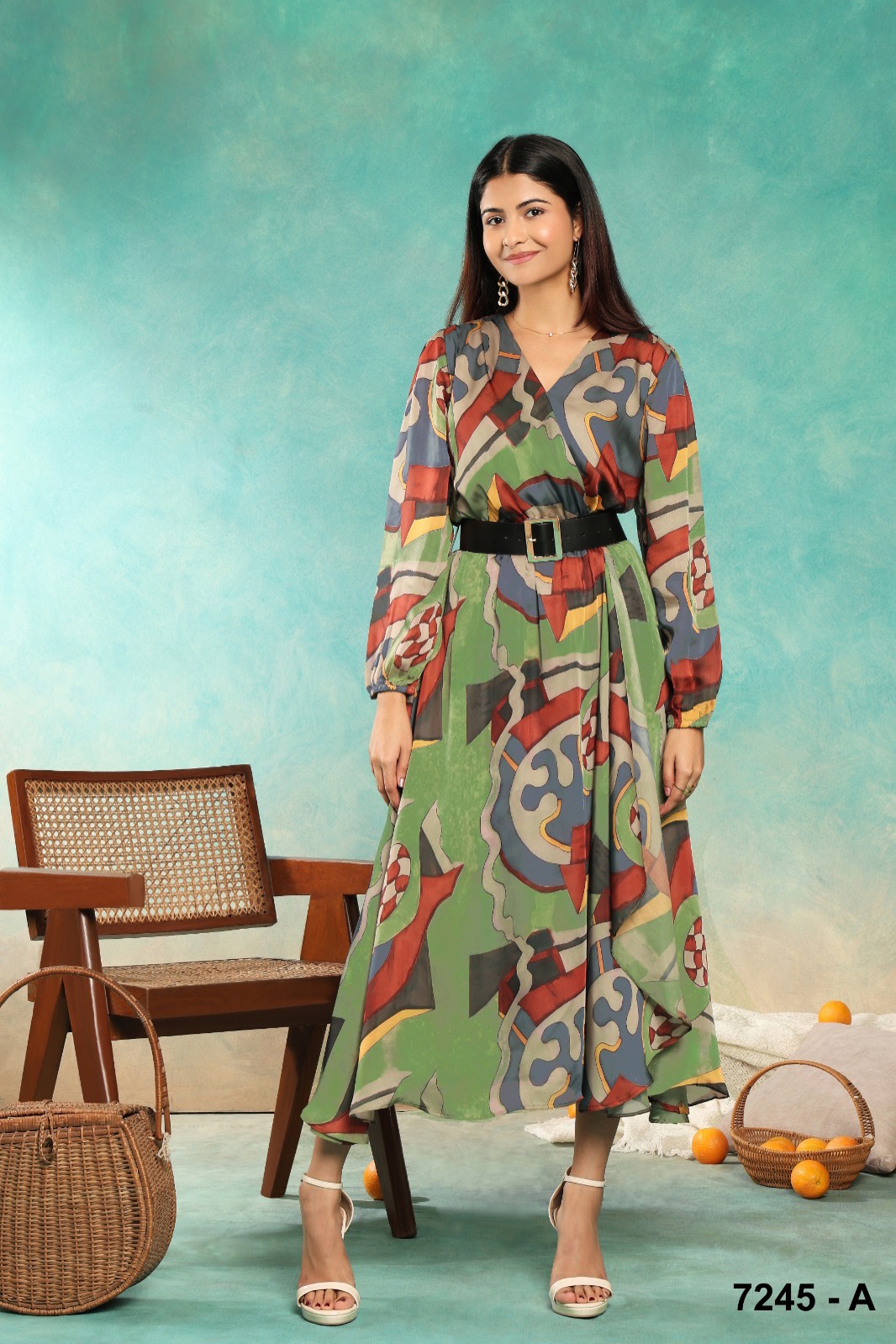
PL. 05 Spec sheet 05 / 15
Wrap dress
One panel crosses the other and ties at the waist.
- 01 What defines it
- A front formed by two panels that cross over the body and fasten at the waist with a tie, hook or button. The crossover creates a V-neckline automatically — the signature of every wrap dress.
- 02 Construction & shape
- In a true wrap, the panels are separate and the tie threads through an opening in the side seam; a faux wrap is sewn closed for ease. Skirts may be straight, flared or cut with an angled hem.
- 03 Visual character
- Diagonal, fluid and adjustable. The crossing lines lead the eye towards the waist, and the overlap creates gentle movement in the skirt.
- 04 Common fabrics
- Jersey, crepe, georgette, viscose and printed satin — fabrics that drape well and hold a tie without bulk.
- 05 Necklines & sleeves
- Always some form of V; sleeves range from flutter and short to long with gathered cuffs, as in the photograph.
- 06 Styling possibilities
- Adjust the tie to change the fit, or layer a belt over it for a firmer waist. Works with sandals, block heels or ankle boots.
- 07 Occasions
- Office, lunches, travel and festive daytime events; in maxi length, evening receptions.
- Collar on a stand
- Waist tie or belt line
- Button placket
PL. 06 Spec sheet 06 / 15
Shirt dress
Shirting details carried down to the hem.
- 01 What defines it
- A dress that borrows the details of a shirt — collar, button-front placket, yoke and often cuffs — and extends them to dress length.
- 02 Construction & shape
- A collar on a stand, a full or partial button placket, a back yoke, and often a drawstring or self-belt at the waist. Skirts may be straight, A-line or gathered below a waist seam.
- 03 Visual character
- Crisp, practical and endlessly adjustable. The vertical placket draws a clean central line from collar to hem. Belted, it gains a defined waist; worn loose, it becomes relaxed and almost tunic-like, so one dress can carry two quite different moods.
- 04 Common fabrics
- Cotton poplin, chambray, linen, denim, viscose crepe and printed rayon; silk and satin for evening versions.
- 05 Necklines & sleeves
- Point, band and camp collars; rolled short sleeves, cap sleeves or long sleeves finished with cuffs.
- 06 Styling possibilities
- Wear it buttoned and belted, unbuttoned as a light coat over trousers, or with sleeves rolled. Sneakers, loafers and kolhapuri-style flats all suit it.
- 07 Occasions
- Work, errands, travel and weekend lunches; in silk or satin, relaxed dinners. It is also one of the most reliable dresses for travel, because cotton and chambray versions wash and dry easily.
- Contour seams
- Close through the hip
- Straight, fitted hem
PL. 07 Spec sheet 07 / 15
Bodycon dress
Cut to follow the body closely, end to end.
- 01 What defines it
- Short for ‘body-conscious’: a dress cut close to the body throughout, relying on stretch fabric or contour seams so that it follows the line from shoulder to hem. The bodycon has almost no ease.
- 02 Construction & shape
- Stretch knits are shaped with very few seams; woven versions use several contoured panels. Linings, where used, are stretch mesh or jersey. Good versions use a fabric with enough recovery to spring back into shape after a long evening of sitting and moving.
- 03 Visual character
- Sleek, bold and streamlined. Because the outline is so simple, texture — ribbing, bandage strips, sheen — becomes important. Colour carries further than usual, so a bodycon in a deep tone looks graphic while a pale one reads soft and minimal.
- 04 Common fabrics
- Ribbed knit, ponte, jersey with elastane, scuba, bandage knit and stretch satin.
- 05 Necklines & sleeves
- Square, scoop, halter, one-shoulder and high necks; sleeveless or long fitted sleeves.
- 06 Styling possibilities
- A long open blazer, oversized shirt or longline coat softens it for day; for evening, minimal jewellery and a sharp heel.
- 07 Occasions
- Parties, dinners and nights out; as a ribbed midi knit with sneakers, relaxed weekends. A longer, ankle-length knit version is a popular modern variant that feels more relaxed than the classic short cut.
- First tier from the waist
- Gathered tier seam
- Widest at the hem
PL. 08 Spec sheet 08 / 15
Tiered dress
Horizontal layers that widen as they fall.
- 01 What defines it
- A skirt built from horizontal bands, each gathered or flared on to the one above, so that the dress widens tier by tier towards the hem.
- 02 Construction & shape
- Rectangles of increasing length are gathered on to each other; the gathering generates volume. Tiers may begin at the waist, the hip or even a yoke just below the shoulders.
- 03 Visual character
- Airy, relaxed and full of movement. Each seam draws a horizontal line, giving a layered, rhythmic outline. Contrast trims, lace insertions or a change of print between tiers can emphasise the layered construction.
- 04 Common fabrics
- Cotton voile, mul cotton, crinkled georgette, chiffon, rayon and light poplin. Lighter fabrics keep the volume soft; heavier ones make each tier stand out more sharply.
- 05 Necklines & sleeves
- Square, smocked, off-shoulder and tie-front necklines; puff sleeves, flutter sleeves or straps.
- 06 Styling possibilities
- Balance the volume with something neat on top, such as a cropped denim jacket; flat sandals, espadrilles or block heels keep it grounded.
- 07 Occasions
- Holidays, brunches, daytime gatherings and casual celebrations. In satin or a darker colour with a more fitted bodice, a tiered maxi can also step into evening.
- Pleats stitched at waist
- Knife pleats
- Pleats open at the hem
PL. 09 Spec sheet 09 / 15
Pleated dress
Folds pressed or stitched into the cloth.
- 01 What defines it
- Any dress whose skirt, or whole body, is shaped by folds — knife, box, inverted, sunray or accordion pleats — rather than by gathers.
- 02 Construction & shape
- Pleats are pressed or heat-set into the fabric and secured at the waist; some are stitched down for a few centimetres before they release. Sunray pleats are cut from a circle, so they fan outwards.
- 03 Visual character
- Ordered, rhythmic and kinetic. Pleats open as you move and close when you stand still, so the dress changes shape with motion. Narrow accordion pleats create fine vertical lines; broad box pleats feel bolder and more structured.
- 04 Common fabrics
- Polyester georgette and chiffon hold permanent pleats; wool and crepe take pressed pleats; satin pleats catch the light along every fold.
- 05 Necklines & sleeves
- Crew, high, V or halter necklines; fitted sleeves balance the movement of the skirt.
- 06 Styling possibilities
- Keep the bodice clean and define the waist; pointed flats or sleek heels echo the vertical lines. Avoid crushing the pleats under long, heavy layers.
- 07 Occasions
- Office, dinners, celebrations and evening events. A pleated midi in a metallic or satin finish is a natural choice for festive evenings.
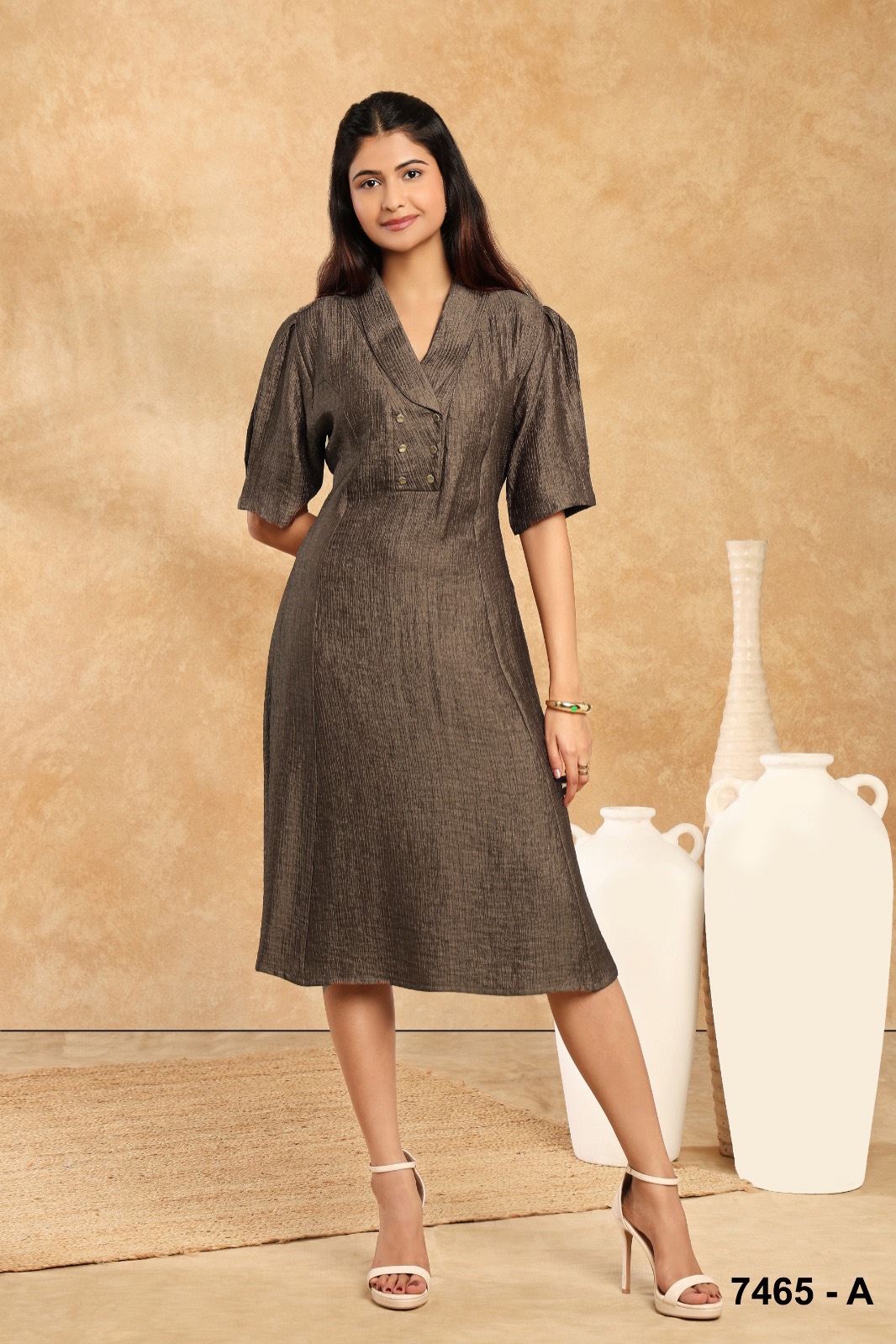
PL. 10 Spec sheet 10 / 15
Fit-and-flare dress
Close at the bodice, then a fuller, swinging skirt.
- 01 What defines it
- A dress fitted through the bodice and waist that releases into a noticeably fuller skirt. The fit and flare dress is more emphatic than an A-line, with a clear contrast between its two halves.
- 02 Construction & shape
- A closely darted or princess-seamed bodice joined at the waist to a circle, half-circle, gathered or pleated skirt. Linings, and occasionally a light petticoat, add volume.
- 03 Visual character
- Defined and playful. The waist becomes a hinge, and the skirt swings and bells out as you move. The contrast between a neat bodice and a lively skirt gives the silhouette a sense of occasion even in a plain fabric.
- 04 Common fabrics
- Cotton sateen, textured jacquard, crepe, taffeta, scuba and satin — fabrics with enough body to hold the flare.
- 05 Necklines & sleeves
- Collared V-necks, sweetheart, square and boat necklines; puff, cap and short sleeves.
- 06 Styling possibilities
- Mary Janes, slingbacks or block heels; a cropped cardigan or short jacket keeps the waist visible. Small, structured bags suit its proportions.
- 07 Occasions
- Parties, birthdays, daytime celebrations and dinners. In cotton or a printed poplin it also works for relaxed daytime outings, which makes it one of the more versatile party shapes.
- Waistline
- Centre-front seam
- Hem at mid-calf
PL. 11 Spec sheet 11 / 15
Midi
Defined by length: between the knee and mid-calf.
- 01 What defines it
- Defined by length rather than cut: a dress whose hem falls below the knee and around the middle of the calf.
- 02 Construction & shape
- Almost any silhouette can be cut to midi length — A-line, wrap, slip, pleated, tiered. The hem must allow a comfortable stride, so slits, vents or a little flare are common.
- 03 Visual character
- Measured and modern. It covers more than a knee-length dress yet still shows the ankle and lower leg. Because the hem sits on the calf, where the leg narrows, the midi tends to look deliberate and balanced in almost any fabric.
- 04 Common fabrics
- Crepe, viscose, georgette, cotton, satin and linen — very nearly everything. The fabric, more than anything else, decides whether a midi is a day dress or an evening one.
- 05 Necklines & sleeves
- Every neckline; elbow and three-quarter sleeves are especially characteristic.
- 06 Styling possibilities
- Footwear sets the mood: pointed flats lengthen the line, ankle-strap heels highlight the gap of leg, and boots ground it in a cold air-conditioned office.
- 07 Occasions
- Work, lunches, family gatherings, dinners and celebrations — the most occasion-flexible length of all.
- Waistline
- Long panel seam
- Ankle-to-floor hem
PL. 12 Spec sheet 12 / 15
Maxi
Ankle- or floor-length: one unbroken line.
- 01 What defines it
- A dress whose hem reaches the ankle or the floor, creating one continuous vertical line from shoulder to foot.
- 02 Construction & shape
- Long panels cut straight, flared, gored or tiered; slits or a generous sweep allow you to walk, and fluid fabrics stop the skirt from becoming heavy.
- 03 Visual character
- Sweeping and elongated — relaxed in light prints, dramatic in satin or velvet. The long vertical line gives prints room to unfold, so large-scale florals, borders and placement motifs often look best at this length.
- 04 Common fabrics
- Georgette, chiffon, rayon, cotton voile, jersey, satin and crepe. Heavier fabrics such as velvet are kept for cooler evenings or air-conditioned venues.
- 05 Necklines & sleeves
- V, halter, wrap, off-shoulder and high necklines; anything from sleeveless to balloon and bishop sleeves.
- 06 Styling possibilities
- Check the hem with the shoes you will wear; use a belt when you want to break the length, or a cropped jacket to add structure.
- 07 Occasions
- Holidays, brunches, festive gatherings and evening receptions. Through Mumbai's monsoon, an ankle length that clears the ground is far more practical than a floor-sweeping hem.
- Bardot neckline
- Sleeve set low
- Natural waist
PL. 13 Spec sheet 13 / 15
Off-shoulder dress
A neckline set below the line of the shoulders.
- 01 What defines it
- A neckline that sits across the upper arms, leaving both shoulders bare — often called a Bardot neckline.
- 02 Construction & shape
- An elasticated, smocked or boned band holds the neckline in place, and the sleeves are set below the shoulder. Ruffles or a deep fold often finish the edge.
- 03 Visual character
- Horizontal, open and romantic, with the emphasis on the collarbones and neck. The wide neckline creates a strong horizontal line across the shoulders, which the rest of the dress usually balances with a defined waist or a flared skirt.
- 04 Common fabrics
- Cotton, poplin, crepe, satin, and chiffon over a stable lining. The neckline band needs a fabric with some grip, so slippery satins are often backed or lined.
- 05 Necklines & sleeves
- The neckline is the point: straight, sweetheart or ruffled; puff, flutter or long bell sleeves.
- 06 Styling possibilities
- Keep the neck clear of heavy necklaces — earrings and hair worn up work better. Built-in support or a strapless bra is essential.
- 07 Occasions
- Holidays, parties, dinners and daytime celebrations. In a structured fabric with a longer skirt, it also suits receptions and dressier evenings.
- Single shoulder
- Bare-shoulder edge
- Clean, level hem
PL. 14 Spec sheet 14 / 15
One-shoulder dress
A single strap draws a diagonal across the body.
- 01 What defines it
- A neckline that rises over one shoulder and leaves the other bare, creating an asymmetric diagonal across the upper body.
- 02 Construction & shape
- The diagonal edge is stabilised with facings, boning or stay tape; there may be no sleeve at all, a single long sleeve or a sculpted drape.
- 03 Visual character
- Striking, sculptural and modern — one strong gesture that needs little help. The diagonal draws the eye across the body, so the rest of the dress is often kept simple to let that line lead.
- 04 Common fabrics
- Satin, crepe, jersey, georgette and scuba. Fabrics with some body hold the neckline cleanly; softer jersey and georgette create a draped, Grecian-style effect.
- 05 Necklines & sleeves
- The neckline defines the dress; sleeve options include a strap, cap, flutter, a single bishop sleeve or a cape drape.
- 06 Styling possibilities
- One statement earring on the bare side, minimal necklaces, a sleek clutch, pointed heels or strappy sandals.
- 07 Occasions
- Evening events, cocktail parties, receptions and formal dinners. Day versions in cotton or linen are more casual and work well for holidays.
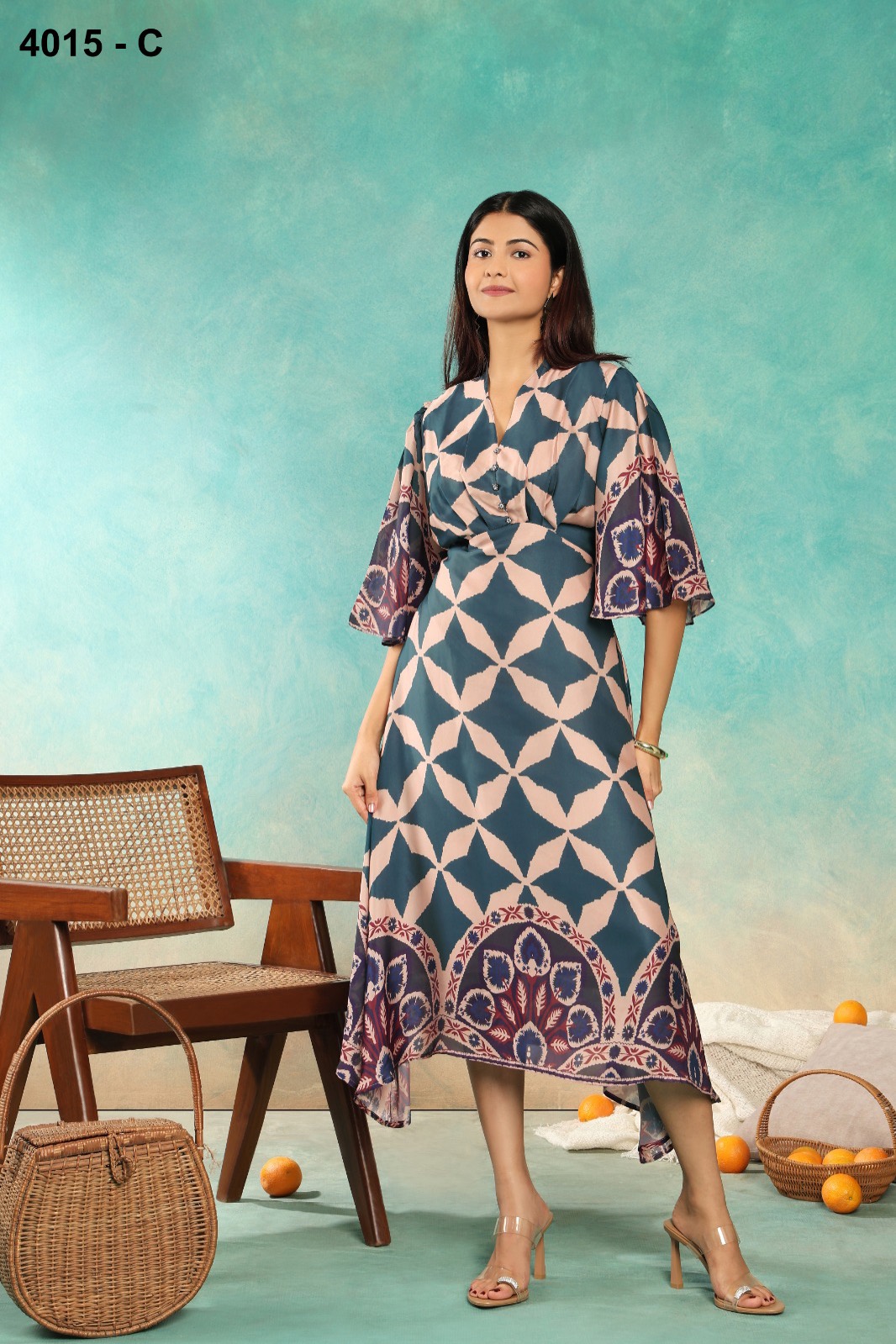
PL. 15 Spec sheet 15 / 15
Asymmetrical dress
An off-balance hem, neckline or seam.
- 01 What defines it
- A dress where one side differs from the other — a hem that runs on a slant or falls to handkerchief points, or a neckline or seam set off-centre.
- 02 Construction & shape
- Asymmetric hems are cut on the bias, from a square (the handkerchief hem) or as a high–low curve; drapes and wraps produce uneven lines naturally.
- 03 Visual character
- Dynamic and contemporary. The eye travels diagonally, and the hem moves differently on each side as you walk. Even a very simple dress in a plain fabric gains a sense of movement and modernity once its hem is cut off-balance.
- 04 Common fabrics
- Georgette, chiffon, crepe, satin and rayon — fluid fabrics let the points fall softly.
- 05 Necklines & sleeves
- Any neckline; flared and bell sleeves echo the movement of a handkerchief hem, as in the photograph.
- 06 Styling possibilities
- Choose shoes that work with both the shortest and the longest point; keep accessories simple and let the hem be the feature.
- 07 Occasions
- Parties, festive gatherings and dinners; printed versions for daytime events. A high–low version with a shorter front is also practical on stairs and in crowded venues, where a long hem can be awkward.
How silhouette, length, fabric and proportion work together
- Empire High waist — a short bodice over a long skirt.
- A-line Natural waist — two near-balanced halves.
- Shift No waist — the dress reads as one block.
A silhouette is only ever a starting point. The fifteen plates above describe outlines, but a dress is read as the sum of four decisions made together: the silhouette that sets the overall shape, the length that decides where the line stops, the fabric that determines how the shape behaves, and the proportion that results when all three meet the body and the clothes worn around it.
Begin with silhouette and length, because they interact more than most people expect. An A-line at the knee feels crisp and light; the same A-line at mid-calf becomes calmer and more considered; at the ankle it turns romantic. A sheath depends on stopping near the knee — lengthen it much further and it needs a slit before you can walk. A maxi, meanwhile, is length first and silhouette second: almost any shape becomes a maxi once the hem reaches the ankle.
Fabric then changes everything again. Cut a fit-and-flare in stiff cotton sateen and the skirt stands out like a bell; cut it in georgette and the same pattern piece falls into soft folds that barely flare at all. Crepe holds a sheath's precise line, while jersey turns that line into something closer to a bodycon. This is why it is worth reading the fabric before the silhouette when you compare two dresses — the drawing may be identical, but the result is not.
Proportion is where the decisions meet. Every dress divides the figure into parts — above and below the waist seam, covered and uncovered leg, bodice and sleeve. An empire line creates a short upper section and a long lower one; a dropped waist reverses it; a shift refuses the division altogether and reads as one block. Footwear, belts and layers then add or remove dividing lines of their own. A belt over a shift introduces a waist the pattern never had; a long open jacket over a bodycon draws two vertical lines that move it from evening towards the office.
None of these choices are rules about who can wear what. They are tools for deciding what you want a dress to do — lengthen, structure, soften, move, stand out or recede — and they work in the same way for everyone. Once you can see them, you can look at any dress on a rail and know, before you try it on, how its silhouette, length, fabric and proportion will combine.
Looking for dresses by family rather than shape? The women's dresses register sorts them by occasion and length.